Hitachi BSBU
The future of building
maintenance in Japan
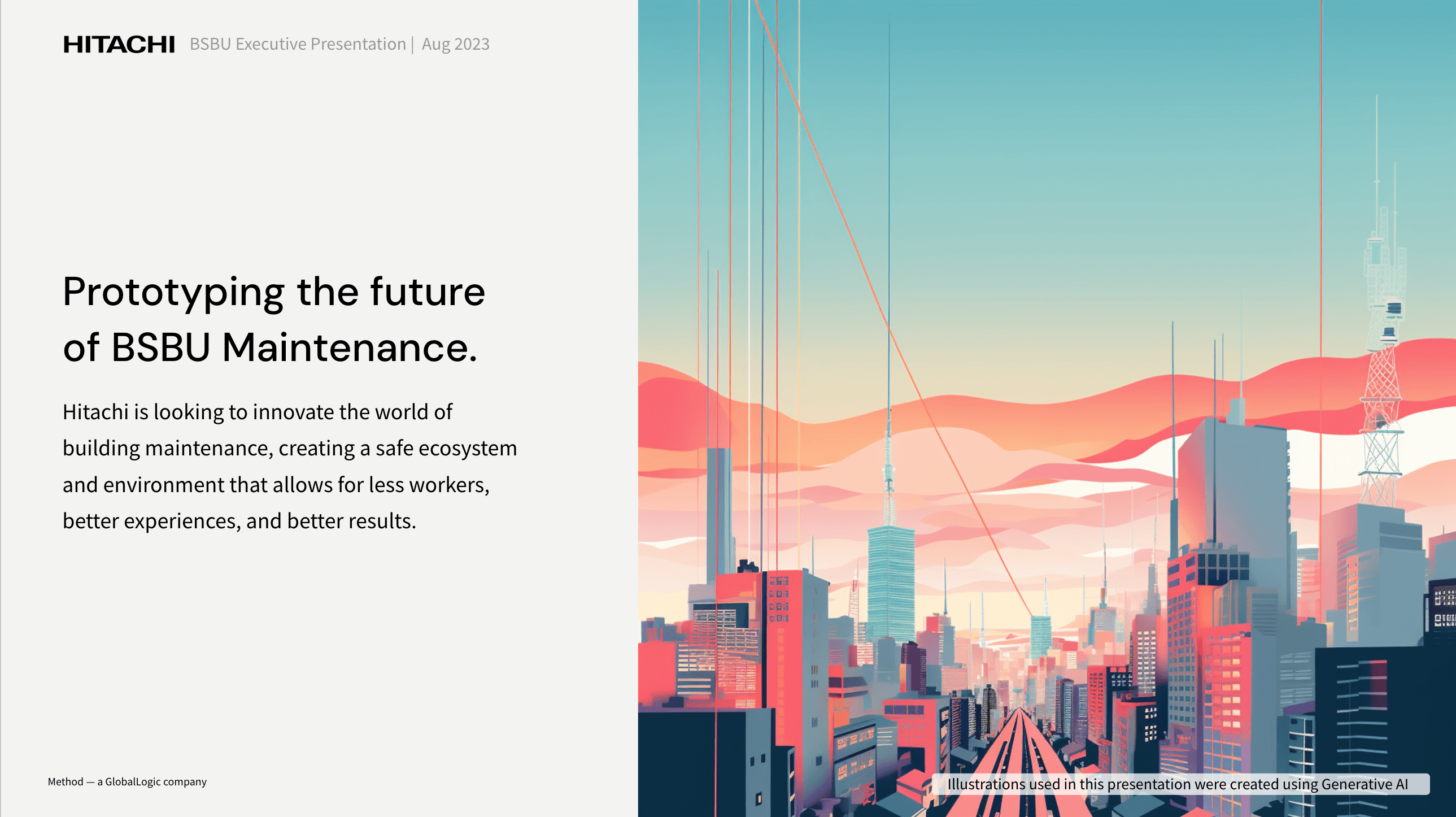
Designing for less workers, better experiences, and better results.


Context
Hitachi is looking to innovate the world of building maintenance. The work I led was the phase 2 for Method work with Hitachi BSBU (Building Services Building Unit).
Phase 1 (Conducted in 2H 2022) explored the specific needs and challenges of elevator maintenance workers expressed through on the ground contextual inquiry, a current state journey map and the exploration of the future journey through workshop & ideation sessions.
Problem
It was believed workers carried too much bulky equipment and that improved technology would create many efficiencies. Building maintenance workers also face incredibly dangerous environments and as a result Hitachi was forecasting a reduced population of Japanese engineers wanting to work in these roles.
There were 4 key areas of opportunity.
Data is written by hand and is not available to other members or systems.
Maintenance workers switch between many devices to do their job and record work.
Hitachi is experiencing and expecting more decline in workforce due to an aging population and dangerous work conditions.
Poor usability of digital tools today hinders consistent and effective use.
Objective
During phase 2 our goal is to focus on prototyping and validate key scenarios that illustrate the story of what maintenance work could look like in 2027-2030.
Our prototyped vision was validated with BSBU Engineers in Japan and packaged for presentation to the BSBU executive committee with the goal of securing funding for development and hardware acquisition for the coming years budget.
The team had 3 main objectives.
Design a rich and nuanced vision for the future of Hitachi building maintenance.
Validate that vision with Japanese building maintenance engineers - testing conducted in Japanese.
Present the findings to the Hitachi BSBU board to secure funding for building this digitally enabled future.


Today's challenges faced by Hitachi Engineers (Referred to as FE's)
We worked to understand the daily routines of maintenance workers, along with the processes, tools, and technologies they use. We Examined patterns in daily routines and mapped them to a current state user journey. Resulting in Identifying pain points, obstacles, and themes that led to opportunities for design intervention.
Our research can be grouped into the following ten themes, which we consider to be areas where there are significant opportunities for intentionally-designed transformation.

Data is written by hand and is not available to other members or systems.

Maintenance workers switch between many devices to do their job and record work.

Hitachi is experiencing and expecting more decline in workforce due to an aging population and dangerous work conditions.
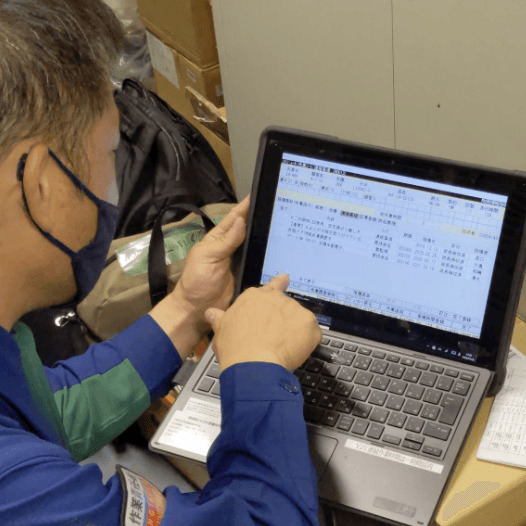
Poor usability of digital tools today hinders consistent and effective use.

The Vision
Harnessing the power of AI + Human Engineers working together.
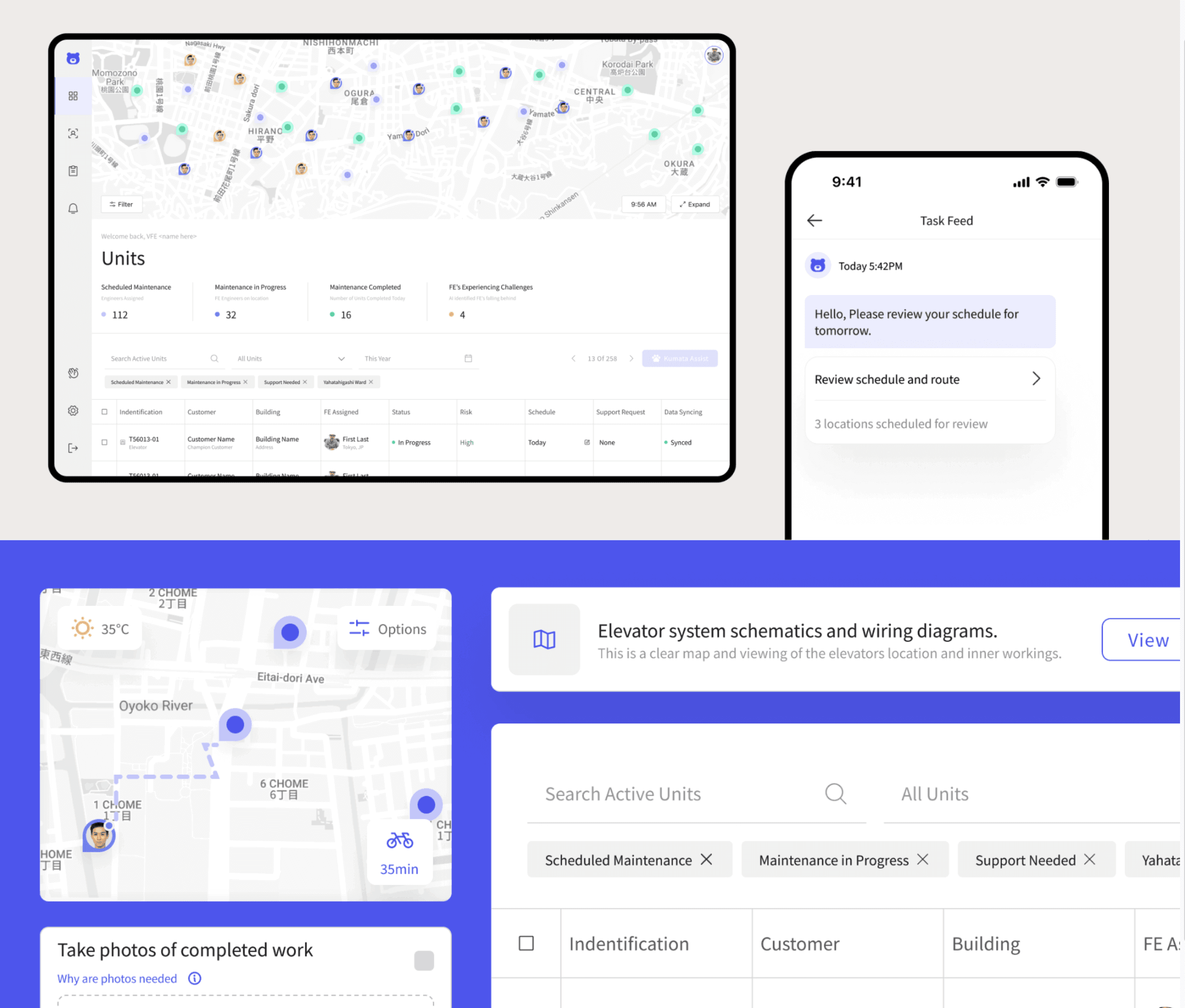
Using a combination of AI powered IOS App and Desktop experiences. This vision illustrates a future that improves not just the experience, efficiency and safety of field engineers, but accounts for a future decline in FEs and an increase in camera and sensor diagnostics.


Optimizing daily workflow
From a linear to a integrated workflow.
The future vision proposes a move from a linear FE workflow to one that allows for the synchronization of activities throughout the day, reducing the margin of error for communication and scheduling, duplication of data, and manual input.
Storyboarding
Prioritization of use cases that would be most impacted by this vision.
Storyboarding allowed us to align on key interactions, business and back end data context, as well as define value creation points.
Working low-fi in this way allows for rapid ideation, collaboration and time efficiency.
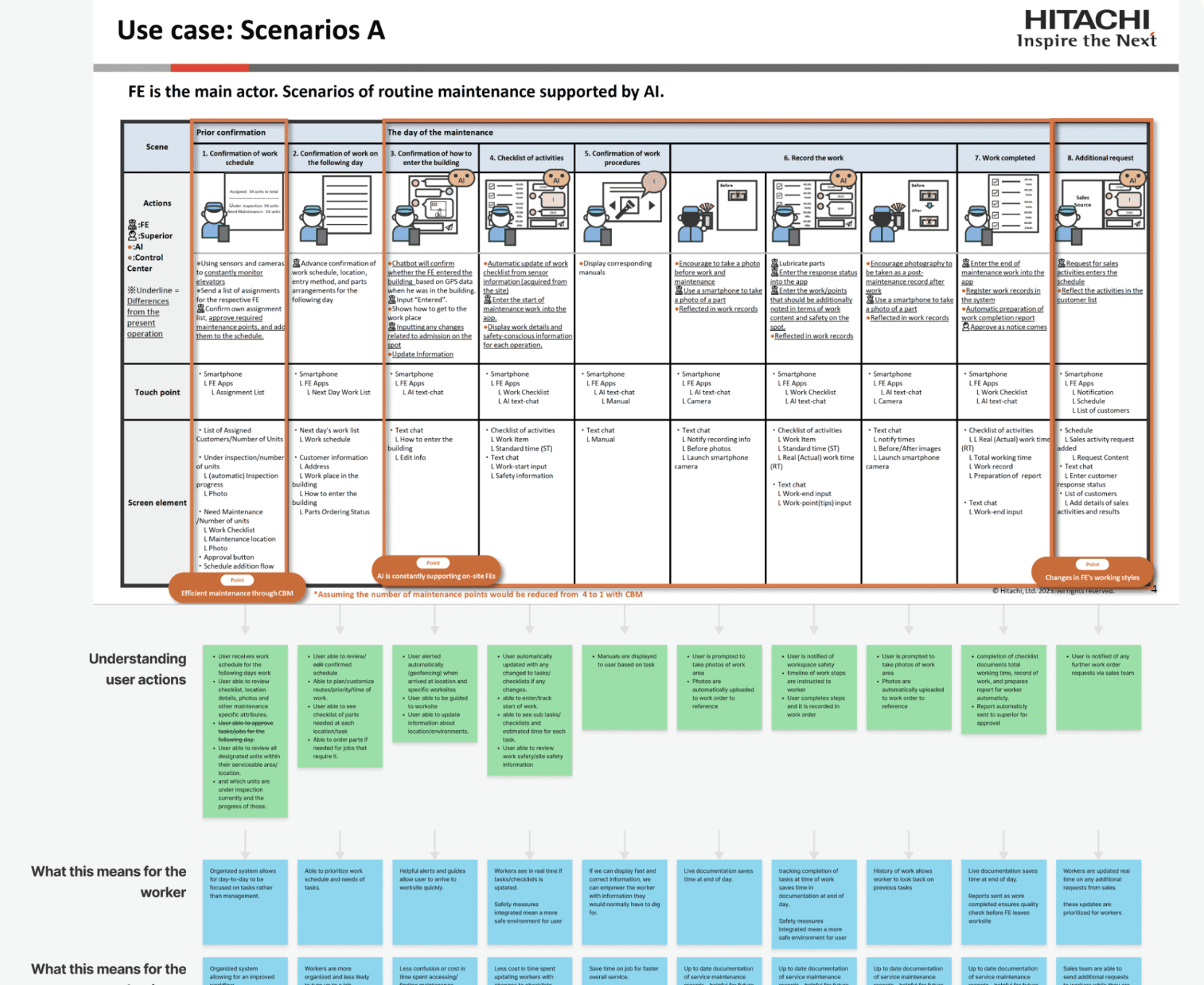

Use Case A
A field engineers journey.
Routine maintenance supported by the AI powered pp
Scenario 1: Schedule sent to FE the day before maintenance for review
Scenario 4: FE begins tasks after reviewing diagnostics
Scenario 2: Next day; FE arrives at the worksite and attempts to access building
Scenario 5: Safety alert and progress indication
Scenario 3: FE arrives at the worksite and prepares to begin tasks
Scenario 6: FE completes work/tasks at this location

Example Scenario
Schedule sent to FE for review and confirmation.
FE receives the schedule and maintenance details for tomorrow's work.
Proactive distribution of work schedule by AI
Route, transport and direction planning
AI powered diagnostic summary and task checklists
Health & safety environment warnings


Initial qualitative, remote moderated User testing for the 2027 - 2030 vision of ‘Kumata’ AI assisted FE maintenance.
Helps us understand big-picture user preferences
Uncovers perceptions, motivations, attitudes and trends
Gathers verbal and open-ended data
Generalizes data from a smaller test group


Remote, moderated
testing methodology
Using a combination of Figma design prototypes, recorded teams meetings, and a structured note taking and synthesis spreadsheet.

Use Case A: Routine maintenance supported by AI powered app.
Insight's gained
“I’m worried that an alert will interrupt my work. In most sites, alerts about heat stroke are expected to occur frequently...” - Member FE, 8 yrs
Scheduling works today but could be more efficient
Insight: Sharing of changes in location access seems valuable
Uncertain of effectiveness of voice control
Challenge in the learning curve required for the new experience
Concern on dependency of overuse of iphone
Disruptive alerts
Human intervention in reporting content and process
Use Case B: Routine maintenance supported by AI powered app.
Insight's gained
“Be careful about the AI's judgment and how it communicates. I get angry if the AI judges me to be “in trouble” based on the mere fact that I'm late, and then it sends me a manual in the middle of work and goes out of its way to tell me what I'm already trying to do. If you are told that you are behind schedule, you will rush things and the safety risk will increase even more.” - Team Leader, 13 years
Centralized system is an exciting prospect
The system needs to be adaptive to different levels of FE’s skills and experience.
AI powered remote support is not a substitute for good human communication
More cameras and sensors, means more maintenance.
Wary of AI’s role and judgement of performance
Concerned about AI documenting the most helpful information
Opportunities for the future

Tool RFID Tags
Accurately manage and locate all RFID tagged tools in a certain room or location and receive reminders when tools have been forgotten.

Dark Mode
Improve visual ergonomics by reducing eye strain, adjusting brightness to current lighting conditions, and facilitating screen use in dark environments – all while conserving battery power.

Noise Cancelling Headphones
Open-ear headphones designed to produce high-quality sound, noise cancelling technology, and clear voice control throughout the work.

Assisted Reality Technology
Integration of Assisted Reality (aR) solution that provides all frontline workers with an industrial strength, hands-free, voice-controlled smart device, that allows you to deliver real-time access to experts.

Health Monitoring Devices
Use of a health monitoring device to track heart rate and blood pressure and ensure FE remains in a healthy state throughout work.

Additional Cameras and Sensors
Future opportunities to add additional cameras and sensors to increase vision of parts status without FE’s entering elevator shaft.